The science of “feel‑good” spaces
It sounds intuitive: a room that “feels right” boosts mood. But modern research is beginning to map exactly how architecture affects health, cognition, and emotional state.
A review of architectural stimuli finds that design can influence physiology, mood, and well‑being from daylighting to spatial layout and materiality.
In office settings, changes in daylight illumination shift levels of calm, interest, and cognitive engagement.
Room shape, proportions, and ceiling heights influence stress, heart rate, and affective states.
The built environment doesn’t just act as background. It can nudge behavior: encourage movement, social interaction, or mental rest, if designed well.
In short, architecture is neurobiology in disguise. Every beam, window, sound path, and room volume is a signal. A home can either be a sanctuary or a subtle stressor.
There’s also a psychological framing of well‑being: hedonic (how good one feels) and eudaimonic (how meaningfully one functions). Buildings & Cities A well‑designed home should support both comfort and flourishing.
Design features that reduce stress and improve quality of life
What design moves actually contribute to health, calm, productivity, and emotional resilience? Below are principles you can look for or demand in any North Cyprus property.
1. Generous, well‑controlled natural light
Daylight helps regulate circadian rhythms, supports mood and alertness, and reduces dependence on artificial lighting.
Avoid glare and harsh contrasts, diffuse light, and transitional zones help.
Windows should have views of nature or sky, not just internal walls.
2. Spatial hierarchy & proportionality
Rooms that scale humanly, neither too cavernous nor claustrophobic more comfortable.
Intermediate spaces (vestibules, semi‑private zones) help a gradual transition, giving the mind “breathing spaces.”
Ceilings with variation can improve spatial interest and reduce monotony.
3. Acoustics & sound control
Quietness is underrated. Good sound insulation between rooms, walls, floors, and from outside traffic makes a huge difference.
Use absorptive surfaces (wood, fabric, textured walls) to reduce reverberation.
Biological and water sounds (water features, gentle fountains) can mask unwanted noise and have calming effects.
4. Material & tactile variety
Natural materials bring warmth, texture, aging, grace, and multisensory richness.
Material contrasts support interaction and interest.
Avoid large expanses of cold, uniform surfaces, which can feel sterile.
5. Connection to nature (biophilia)
Indoor‑outdoor flow: terraces, courtyards, balconies, green walls.
Planting is visible from the interiors.
Water, stone, and vegetation cue rest, lower stress, and enhance recovery.
6. Social & transitional spaces
Homes that include semi‑public or shared “living room corridors,” lounges, or plazas encourage incidental interaction, hence reducing isolation.
Transitional zones (entrance halls, nooks, alcoves) give mental pause, a buffer between exterior and interior.
7. Choice & control
People feel better when they have agency: the ability to modulate light, airflow, privacy, and shading.
Windows or blinds under human control, flexible partitions, convertible rooms.
When these elements combine, a home stops being just a physical container and becomes a supportive environment for mind and body.
Dovec Group’s approach: blending private comfort with social spaces
In the North Cyprus property sector, some developers chase flashy facades or tech gimmicks. Those who succeed in the long term are those who balance private sanctuaries with socially vibrant infrastructure. Dovec Group appears to grasp this balance.
While public details are limited, here’s how Dovec Group seems to incorporate psychologically smart design elements:
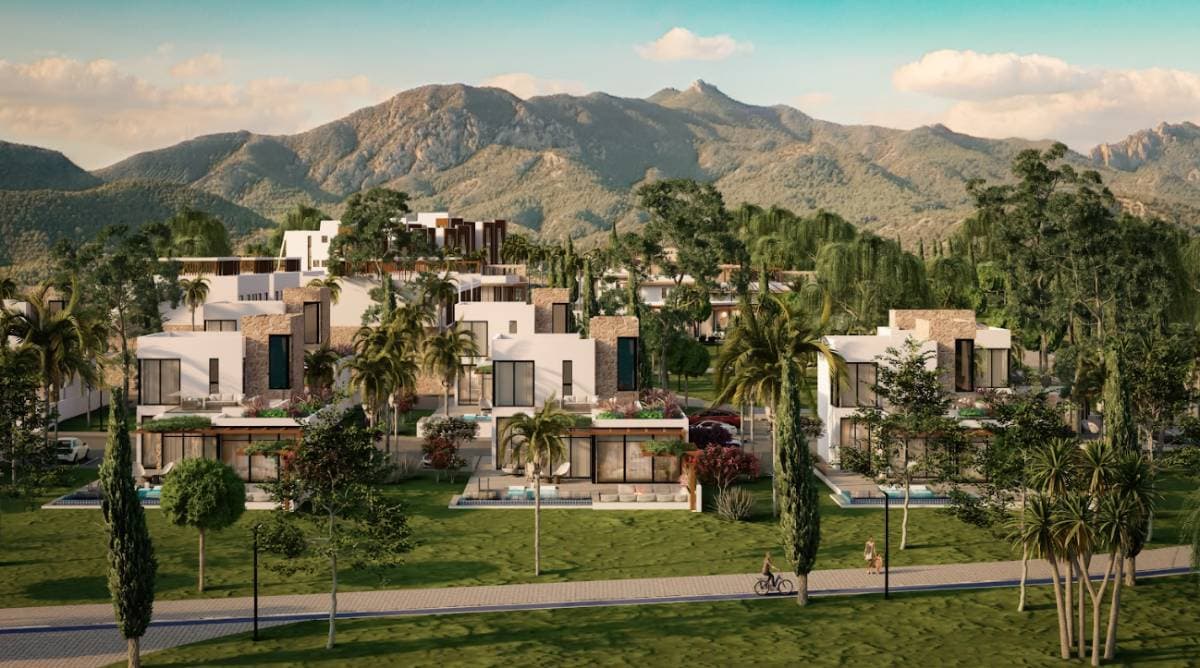
Their projects often emphasize courtyards, shared gardens, communal lounges, and social amenities, spaces where residents can gather or rest.
They integrate landscaped open space as part of the project footprint, green zones, pathways, and gardens that become visible from many units, not relegated to the periphery.
In developments near the coast and hills, they respect topography and views, units are sited to capture sea, sky, light, not block them. You can view and visit Dovec projects virtually via 360 virtual tour.
Dovec Group emphasizes after‑sales services, social programs, and community engagement, which encourage belonging.
Their design language often includes architectural articulation, façade relief, variation in volume and depth rather than flat, repetitive blockssupporting visual interest and psychological richness.
In practice, this means buyers in a Dovec Group project get more than a four‑walls box: they gain access to spaces that buffer stress, nurture connection, and help people live more than exist.
If Dovec Group further adopts explicit design principles (light modulation, acoustic zoning, material richness), their projects could become psychological benchmarks in North Cyprus.
Why investors should care: well‑being drives long‑term demand
You might think, “Is this artistic talk? Does well‑being really sell or pay off?” The short answer is: yesand in subtle, multiplicative ways.
1. Differentiation in a crowded market
As more developments enter the North Cyprus property space, offerings blur. Well‑being becomes a unique selling point: “this home makes you feel better” is a claim that few can credibly offer.
2. Stronger retention, lower turnover
When residents love their homes not just for aesthetics but for comfort and harmony they’re less likely to sell or downgrade. That stabilizes pricing and avoids discounting cycles.
3. Rental & premium pricing power
Well‑designed homes command higher rents, especially from discerning tenants (professionals, expats, wellness‑minded buyers). The intangible “feel factor” lets owners and developers push premium rates.
4. Resilience against fads
Tech features age. Style trends fade. But a space that works for human nature has longevity. Homes built for psychological health are less vulnerable to becoming obsolete.
5. Positive brand & ecosystem effect
Developers known for nurturing well‑being gain reputational goodwill. That helps with sales velocity, community support, and price multipliers in future phases.
6. Public & regulatory goodwill
Homes that prove they reduce stress, promote health, and build community are more likely to win support for zoning, permits, and community buy‑in especially in markets sensitive to social impact.
So in effect, investing in psychological smartness is not altruism; it’s a strategy. Well‑being is a durable lever of value.
Published 17 October 2025