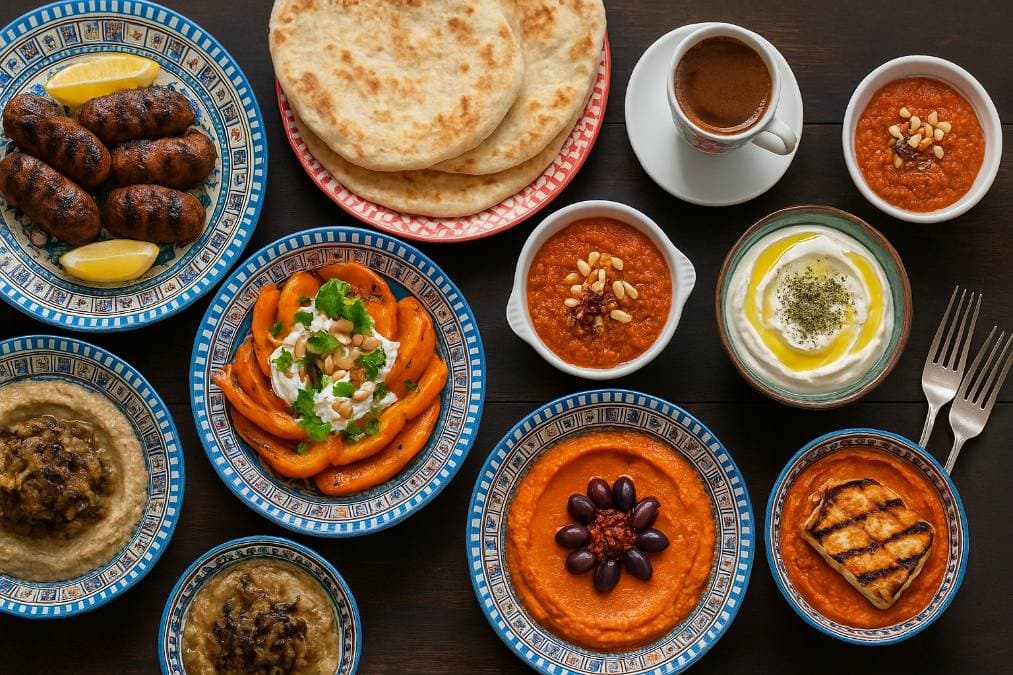
Cyprus' food is more than a collection of dishes; it is memory, identity, and the story of a people shaped by the Mediterranean, by migration, and by deep-rooted tradition. In Northern Cyprus, the cuisine of Cyprus reflects a meeting point of Turkish, Middle Eastern, and Greek influences, yet it has grown into something distinctly its own.
For anyone visiting the island, discovering traditional Cypriot food is one of the most unforgettable experiences. Ask anyone who has been to the island what they remember most and it is not only the beaches or the Venetian walls, but the taste of hellim straight from the grill, the aroma of a slow-cooked fırın kebabı, or the comfort of a home-cooked molehiya shared around a crowded family table.
This is your guide to Cypriot cuisine, shaped by the everyday life of Turkish Cypriots, the traditions of the TRNC, and the flavors that define this Mediterranean island.
Why Cypriot Cuisine Is So Special
The island’s food culture is a fusion, but it is not a copy of anything. Cypriot dishes carry stories of Ottoman kitchens, Levantine spices, village ovens, shepherd traditions, and the agricultural lifestyle that still shapes Cyprus' meals today.
The Cyprus traditional kitchen is built on three foundations:
local produce grown in fertile Mediterranean soil
home-cooking traditions passed down through generations
community and sharing, where food means gathering
In Northern Cyprus, you rarely see someone eating alone. Tables are long, meals are slow, and conversations last long after the plates are empty. Food is a language of its own.
A Morning in Cyprus: The Traditional Cypriot Breakfast
The day begins slowly here. The morning feast begins with traditional food from Cyprus.
A typical Cypriot food ritual in the morning features:
freshly sliced hellim (halloumi) fried until golden
çakıstez local cracked green olives
village bread still warm from the bakery
homemade jams
nor cheese
tomato, cucumber, olive oil
And in summer:
The legendary combination of watermelon and hellim, a Northern Cypriot classic. Breakfast is not just a meal, it is a peaceful start to the day, a moment shared with family.
Halloumi: The National Food of Cyprus
No discussion of Cypriot cuisine recipes is complete without hellim.
Made from goat and sheep milk, halloumi’s squeaky texture and salty flavor are instantly recognizable.
It can be:
grilled
fried
eaten fresh
added to salads, sandwiches, or pasta
For Turkish Cypriots, hellim is not just cheese it is heritage. Many families still prepare homemade versions, firmer and more aromatic than the commercial ones.
Zeytin & Olive Oil: Heart of Cypriot Meals
Zeytin (olives) are essential in almost every Cyprus meal. Especially famous is çakıstez, a cracked green olive marinated with:
garlic
coriander (gollandro)
lemon
olive oil
Olive oil itself is a star ingredient, true liquid gold of the island.
Molehiya: A Dish With a Story
Among traditional Cypriot food, molehiya holds a sacred place.
This leafy plant traveled from the Middle East centuries ago and became a staple in Northern Cyprus kitchens.
Cooked slowly with lamb or chicken, garlic, lemon, and spices, molehiya is comfort food at its core.
Every Turkish Cypriot home cooks it at least a few times a year often in big pots shared with neighbors.
Its smell alone can bring someone back to their childhood.
Fırın Kebabı: Cyprus Oven-Roasted Perfection
If there is a single dish that represents typical Cypriot food, it might be fırın kebabı (kleftiko). Prepared with lamb, garlic, potatoes, and sometimes veggies, it is slow-roasted for hours in stone or clay ovens.
The result?
tender meat that melts off the bone
deep aromas
a taste tied to weddings, feasts, and family celebrations
This is a dish that represents tradition in its purest form.
Kolokas & Bullez: Cyprus Root Vegetable Classics
Northern Cyprus has its own unique produce; kolokas (gölevez) is one of them.
This root vegetable:
becomes tender when slow-cooked
pairs beautifully with minced meat or olive oil
has a faint sweetness
Bullez, the younger version, is even softer and often preferred by locals. These dishes are examples of Cypriot food culture that few tourists know but every local loves.
Pastries: A Taste of the Village
Nor Pastries
Nor cheese, lighter than halloumi, is a local favorite for pastries.
You will often find:
nor and mint börek
nor and cinnamon sweet pastries
nor-filled buns in village bakeries
The taste is simple but nostalgic, a true reflection of traditional Cypriot food.
Pirohu: Cyprus-Style Handmade Dumplings
Pirohu is similar to Turkish mantı but with a Cypriot twist; its filling is made from halloumi and mint, not meat.
Served with:
olive-oil yogurt
butter
or sometimes garlic yogurt
Pirohu is a dish of patience and craftsmanship, often prepared during holidays or for special guests.
Ekmek Kadayıfı
Soft, syrup-soaked bread with thick kaymak.
Gatmer (Sini Katmeri)
Layers of yufka filled with local kaymak and sweet syrup.
Paluze
A jelly-like dessert made from grape must is one of the oldest Cypriot recipes.
Lokma
Dough balls fried and dipped in syrup.
Sweets in Cyprus are often shared with neighbors, and with a Turkish coffee on the side, without a doubt.
Babutsa: Northern Cyprus’ Prickly Treasure
This prickly pear fruit is a symbol of Güzelyurt and the countryside.
Refreshing and sweet, babutsa is eaten cold in summer.
Recently, disease and climate changes made it harder to find, making it even more cherished.
Zivaniya: Cyprus’ Traditional Spirit
Zivaniya is a strong alcoholic drink made by distilling grape pomace.
It is drunk in winter, often with meze, and believed to aid digestion.
Locals sometimes mix it with honey during colds.
Cyprus Meze: A Celebration of Togetherness
If kebab culture represents the warmth of the grill in Cyprus, meze represents the island’s soul. Nowhere else in the Mediterranean is the act of sharing food so deeply connected to family, memory, and the rhythm of everyday life. In Northern Cyprus especially, meze is not a simple “starter” or a tasting plate, it is an entire philosophy of living.
Meze is built on the idea that food is meant to be shared, stories are meant to be told, and meals are meant to be slowed down. It is the Cypriot way of saying:
“Sit, relax, taste… we have time.”
A traditional Cyprus meze can include anywhere from 12 to 30 plates, arriving slowly, one by one, as if the meal itself is breathing. Each dish is prepared with care, often following recipes passed down for generations.
A typical meze table may include:
fresh salads with mint and lemon
hellim grilled until golden
humus, cacık, and tahini
patates kizartması with oregano
pickled wild herbs
molehiya or kolokas served in small pots
spicy şeftali kebabı pieces
fried zucchini and aubergine
fresh village bread
olives cured the traditional way
And this is only the beginning. Seafood meze brings grilled octopus, calamari, and tahini-marinated fish; meat meze leads into şiş, köfte, and slow-cooked fırın kebabı.
Every plate carries its own story, its own tradition, its own little slice of Cypriot life.
The Kebab & Souvlaki Culture of Cyprus: A Tradition That Brings Families Together
Across Cyprus, especially in the Turkish Cypriot communities of the north,kebab culture is far more than a meal. It is a ritual, a gathering, a rhythm of life that moves from village to village, terrace to terrace, and family to family.
On this Mediterranean island, grilling is not treated as a casual weekend activity. It is a social institution, passed down from fathers to sons, from grandmothers to grandchildren. No celebration feels complete without a mangal burning, the scent of marinated meat drifting through the neighbourhood, and relatives calling one another to come and “taste it while it’s hot.”
This shared culture is similar in spirit to the Greek Cypriot souvlaki tradition simple ingredients, charcoal, and time spent together. Yet in Northern Cyprus, kebab has its own personality: earthier, heartier, more rustic, shaped by generations of Turkish Cypriot family life.
Whether it is a Sunday gathering, a seaside picnic, a village wedding, or a quiet evening at home, kebabs and souvlaki-style grills are the centrepiece of Cypriot hospitality. Preparing food together, sharing bread from the same tray, and passing lemon wedges across the table form the essence of Cypriot togetherness.
This is why people often say:
“In Cyprus, the grill is where the real conversations happen.”
Şeftali Kebabı: The Soul of Turkish Cypriot Grilling
Among all the meats sizzling on Cypriot charcoal grills, Şeftali Kebabı holds a place of honour. To visitors, it may appear as a simple sausage-like kebab but to Turkish Cypriots, it represents childhood memories, family traditions, and the very identity of the island’s cuisine.
Despite its fruity name, Şeftali Kebabı has nothing to do with peaches. The dish is born from the legacy of a Turkish Cypriot cook named Şef Ali, whose recipe became so beloved that locals began referring to it as “Şef Ali’nin kebabı.” Over time, the name softened into “şeftali,” creating a charming linguistic twist that still amuses Cypriots today.
The recipe is deceptively simple:
minced lamb or beef
finely chopped onion
fresh parsley or cilantro (coriander)
salt, pepper, and light spices
all wrapped inside gömlek yağı caul fat
pitta bread
As the kebab cooks over hot charcoal, the fat melts slowly, keeping the meat juicy and flavourful, while forming a delicate golden crust. The aroma is unmistakably smoky, savoury, with a hint of the herbs that define the traditional Cypriot food culture.
FAQ About Cypriot Cuisine
What is the national food of Cyprus?
Halloumi and fırın kebabı are widely considered national symbols and as the pillars of Cyprus traditional food.
Is Cypriot food similar to Turkish food?
There are similarities, but Cypriot dishes are more olive oil-focused with Middle Eastern and Mediterranean touches.
Is Cyprus' food healthy?
Mostly yes: vegetables, legumes, and olive oil dominate the cuisine.
What is molehiya?
A slow-cooked leafy dish with lamb or chicken, traditional to Cyprus.
Are there vegetarian Cypriot dishes?
Many: molehiya (meatless), kolokas, salads, tahini dips, and more.
To Taste Cyprus Is To Know It
Cypriot food is a cultural tapestry woven with history, family, tradition, and the flavors of the Mediterranean.
Whether you try halloumi at a beach taverna, molehiya in a village home, or şeftali kebabı from a street vendor, each bite carries the island’s soul.
If you want to understand Northern Cyprus, begin with its kitchen.
Published 17 November 2025